Introducing SignalHub: The End of Information Overload
SignalHub is an AI powered tracking and filtering tool built to solve information overload for professionals. It monitors news sites, blogs, web pages, and RSS, then uses your natural language intent to filter noise, summarize updates, and deliver only high signal alerts to your existing workflow tools.
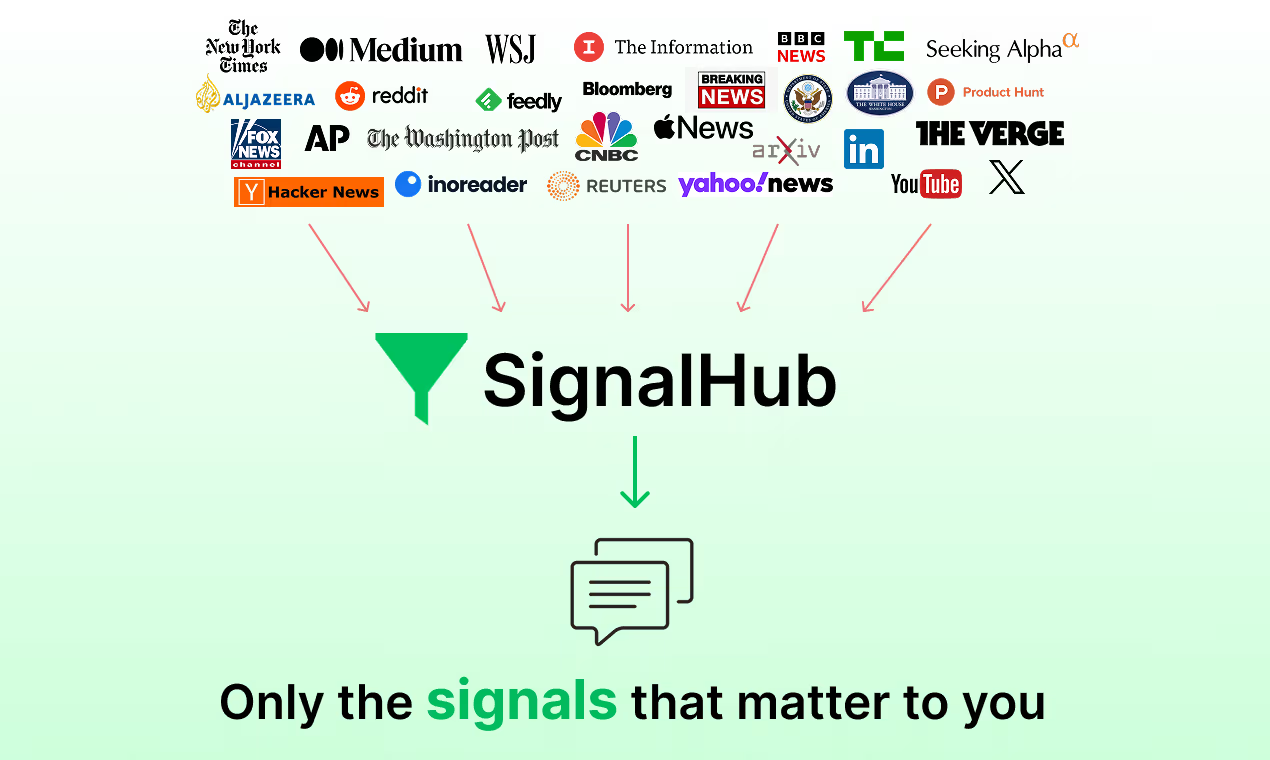
Information overload is the real problem
Information overload is not just annoying. It slows down work.
If you do market research, competitive intelligence, product tracking, security monitoring, or investing research, you probably check many sources every day. News sites. blogs. RSS feeds. newsletters. Reddit. X. YouTube. Company pages. Changelogs. You still miss important updates, because there is simply too much to read.
Most news apps are built for casual reading. Most RSS readers are built for collecting everything. Both create the same outcome. Too much noise. Too little signal.
We built SignalHub to end information overload with an AI powered tracking system.
Why we built SignalHub
As a corporate strategy professional and AI developer, I needed to track real changes on the web: competitor launches, pricing updates, policy shifts, and product moves. The hardest part was not finding sources. It was filtering them fast enough to avoid missing the few updates that actually matter.
Many people try to solve this with an RSS (Really Simple Syndication) reader like Feedly or Inoreader. RSS is great for collecting sources, but it often becomes a firehose. You still spend time skimming, sorting, and saving items for later, and important updates can still get buried under noise and clickbait.
SignalHub is built on a simple philosophy: your attention is precious. Instead of showing you everything, an LLM (large language model) should read updates for you, filter them based on your intent, and only deliver high signal notifications to your workflow.
That is why we built SignalHub: less scrolling, more knowing.
How SignalHub works
1. Track any source on the web
SignalHub supports RSS feeds, news sites, blogs, and most web pages. You can monitor product pages, pricing pages, job pages, policy pages, changelogs, and more. No technical setup. Paste a URL and start tracking.
This is useful for web monitoring and competitor tracking, where changes matter more than headlines.
2. Describe your intent in natural language
You tell SignalHub what you care about. Your prompt can be short or detailed. A short prompt keeps coverage broad. A detailed prompt gives tighter filtering and higher signal.
Short preference prompt example:
Only notify me about high impact news in the global semiconductor and computing infrastructure industry.
Detailed preference prompt example:
Act as a hard tech journalist. Track global chips, semiconductors, and computing infrastructure, and only notify me about high impact events: major technical breakthroughs, meaningful product launches or upgrades, key earnings and guidance signals, major capex and capacity moves, export controls or supply chain disruptions, and major funding or M and A (mergers and acquisitions) for high impact startups. Prioritize advanced chips and processes (CPU, GPU, NPU, DRAM, NAND, HBM, lithography, equipment and materials), computing infrastructure (AI servers, GPU clusters, hyperscale data centers, networking and interconnect), and enabling tech (EDA, IP, CoWoS, chiplets, packaging and testing). Focus on leaders such as NVIDIA, AMD, Intel, Qualcomm, Apple, Arm, TSMC, Samsung, ASML, Applied Materials, Lam Research, KLA, Tokyo Electron, AWS, Microsoft Azure, Google Cloud, Meta, Broadcom, Marvell, Synopsys, Cadence, and Siemens EDA. Ignore pure PR, minor updates without real capability gains, small funding rounds, and routine partnerships. For each match, output 3 bullet takeaways plus a clear “what happened” and “why it matters,” and only cite commentary from globally trusted outlets or top research teams.
This is not a simple keyword alert. It is intent based tracking, powered by LLM understanding.
3. AI filtering, AI summarization, and relevance scoring
SignalHub reads every update, summarizes the key points, and checks whether it matches your preferences. Only the matched items become signals. Everything else is filtered out before it reaches you. Unlike a typical news aggregator, SignalHub is built to reduce noise, not collect more content.
4. Multilingual tracking and auto translation
SignalHub can monitor high quality sources in any language and deliver signals in the language you prefer. You can follow Japanese, Korean, Chinese, or European sources without switching languages or doing manual translation. The AI translates and summarizes each matched update, so you can stay global while reading in your own language.
5. Workflow first delivery
SignalHub is designed for professionals. Signals can be delivered directly to the tools you already use, including Email, Telegram, Discord, Slack, Microsoft Teams, Google Chat, Ntfy, Pushover, WeCom, Lark, DingTalk, and X (Twitter). You do not need to open another app just to stay informed.
How SignalHub compares to alternatives
Traditional RSS clients like Feedly and Inoreader are excellent at collecting sources. However, users still have to scan long feeds, maintain folders, and create many rules to reduce noise. Their AI features are usually not native to the core workflow. They are add ons that help you analyze or search the content after it has already been collected. The bigger issue is cost. When the volume of items is high, AI analysis becomes expensive, which is why these AI add ons are often priced very high.
There are also newer products that share a similar high level idea with SignalHub, letting AI filter information for you, such as Syft, Ancher, and Yutori. But different philosophies lead to different product designs, which means they serve different users and different use cases. We will publish a detailed comparison in a follow up post.
What's Next?
We are early, and we are building fast. Next on our roadmap includes:
Social and community sources, such as Reddit, X (Twitter), YouTube, and more.
Recommend high quality sources, so you do not need to manually curate websites
Use AI to help you improve your preference prompt.
More flexible delivery rules.
More reliable, lower cost web crawling and monitoring at scale.
Better, faster, and more accurate specialized models for filtering.
Stop scrolling. Start knowing.
Try SignalHub today. Your feedback matters, and it helps us make SignalHub better for you.